
Strawberry Shortcake Layer Cake, with a Nod to Paris
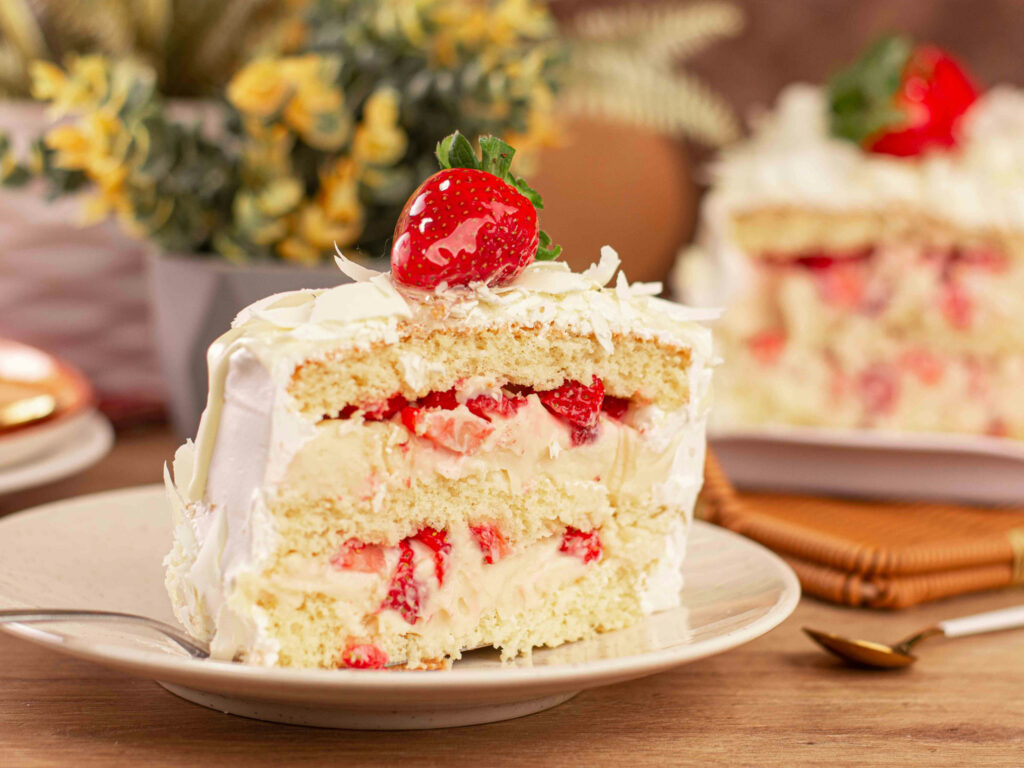
This strawberry shortcake is one of those recipes I’ll never stop making. No matter how many new ideas I bookmark or how many flavour combinations I flirt with, this is the cake I always come back to. It’s familiar in the best way – soft vanilla sponge, fresh strawberries, and whipped cream that’s just sweet enough to feel indulgent without tipping over. It’s also the cake that always makes me think of Paris. Not because it’s French by definition, but because of how strawberries and cream show up there. Walk past a pâtisserie in Paris around Valentine’s Day and you’ll spot le fraisier in the window – neat layers, glossy strawberries, pale cream, quietly beautiful. Romantic without being loud. Special without being heavy. That’s exactly the energy of this cake. I love it for Valentine’s Day because it doesn’t feel themed or performative. There’s no food colouring, no heart shapes, no drama. Just a cake that’s meant to be shared, sliced at the table, and eaten slowly enough to notice how good it actually is. Why I Always End Up Baking This One What makes this strawberry shortcake such a favourite is how easy it is to love. The sponge is light and tender, with real strawberry flavour coming from a reduction rather than anything artificial. The whipped cream keeps everything fresh, and the strawberries do most of the talking. It looks beautiful once it’s assembled, but it’s not precious. You don’t panic when you cut into it. You don’t need a special reason to make it. It’s the kind of cake that disappears quietly, one slice at a time, until suddenly there’s nothing left. Ingredients Strawberry Reduction 450g strawberries (fresh or frozen), hulled 50g caster sugar Vanilla Strawberry Sponge (3 x 6-inch layers) 170g unsalted butter, at room temperature 200g caster sugar 3 large eggs, at room temperature 1½ teaspoons vanilla extract 200g plain flour 1½ teaspoons baking powder ½ teaspoon salt 120ml whole milk 120ml cooled strawberry reduction Whipped Cream Frosting 600ml double cream, cold 90g icing sugar, sifted 1½ teaspoons vanilla extract Filling & Decoration 300–400g fresh strawberries, sliced Method Make the Strawberry Reduction Add the strawberries and sugar to a saucepan and cook over a medium heat until the fruit breaks down and the mixture thickens. This usually takes around 20–30 minutes. Blend until smooth and set aside to cool completely. Prepare the Tins Heat the oven to 170°C fan. Grease and line three 6-inch round cake tins. Make the Cake Batter Cream the butter and sugar until pale and fluffy. Add the eggs one at a time, mixing well after each addition, then stir in the vanilla. In a separate bowl, whisk together the flour, baking powder, and salt. Add this to the batter in two stages, alternating with the milk and strawberry reduction. Mix gently until just combined. Divide the batter evenly between the tins. Bake Bake for 30–35 minutes, until lightly golden and a skewer inserted into the centre comes out clean. Allow the cakes to cool completely before assembling. Whipped Cream Frosting Whip the double cream with the icing sugar and vanilla until soft, stable peaks form. Keep it light — the texture should feel smooth and airy. Assemble Place one sponge layer on a serving plate. Spread over a layer of whipped cream and scatter with sliced strawberries. Repeat with the second layer, then finish with the final sponge, a soft swirl of cream, and strawberries on top.
Pistachio & Vanilla Cake Inspired by a Persian Love Cake
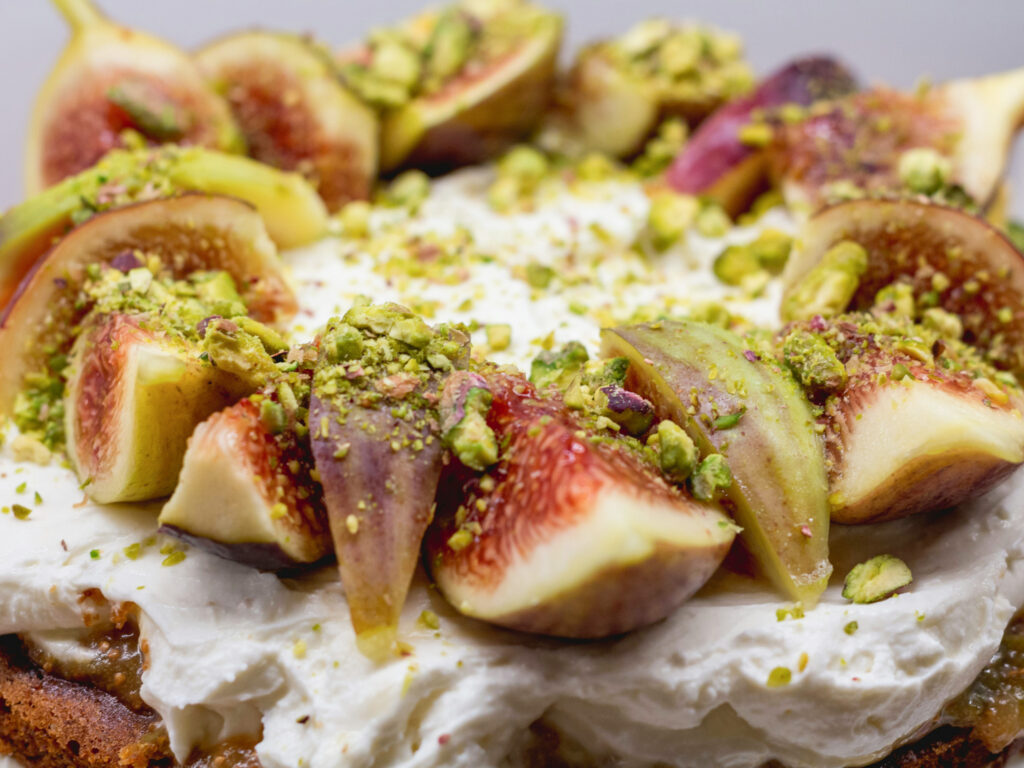
This pistachio and vanilla cake is inspired by a Persian love cake, making it a natural fit for Valentine’s Day baking. It takes cues from the original’s use of ground almonds, citrus zest, warming spices, and syrup-soaked crumb, but shifts the flavour profile away from floral notes. Instead, this version focuses on vanilla, orange zest, cardamom, and pistachios for a flavour that feels warm, balanced, and easy to enjoy. I’ve never really been a big fan of rose water in baking, so this recipe skips it entirely. The result is a cake that works well as a Valentine’s dessert, while still being versatile enough to make again for birthdays, dinners, or any occasion that calls for a layered cake without heavy icing. Designed as a three-layer 6-inch cake, this version uses plain flour instead of semolina, giving the layers a little more structure while keeping the crumb moist and tender thanks to ground almonds, yoghurt, and syrup. What Is a Persian Love Cake? Persian love cake is a Middle Eastern-inspired almond cake, typically made with ground almonds, citrus zest, and warming spices such as cardamom, then soaked in syrup after baking. It’s known for its dense yet moist texture and its aromatic flavour, which often includes floral notes like rose water. This recipe isn’t a traditional Persian love cake. Instead, it’s a layered cake inspired by those core flavours and techniques – the use of almonds, citrus, spice, and syrup – adapted into a format that stacks well and leans towards a more familiar vanilla-led profile rather than floral flavours. Why This Version Works Well as a Layer Cake Plain flour gives structure for stacking Ground almonds keep the crumb moist Pistachios add texture without weighing the cake down The syrup keeps the layers soft for days The flavour profile suits Valentine’s baking without being overly sweet If you make this, I’d love to know how you get on – especially if it becomes part of your Valentine’s plans. Pistachio & Vanilla Cake (Inspired by a Persian Love Cake – 3 × 6-inch Layers) Makes: 3 × 6-inch cake layersOven: 170°C fan / 190°C conventional Ingredients For the cake layers 180g ground almonds 110g plain flour 2 tsp baking powder ½ tsp bicarbonate of soda 1½ tsp ground cardamom Zest of 2 oranges 180g unsalted butter, softened 220g caster sugar 4 large eggs, at room temperature 2 tsp vanilla extract 180g Greek yoghurt 120g pistachios, finely chopped For the syrup 180ml water 150g caster sugar Juice of 1 orange 1 tsp vanilla extract To finish Chopped pistachios Icing sugar Method 1. Prepare the tins Grease and line the bases of three 6-inch round cake tins. Preheat the oven to 170°C fan. 2. Mix the dry ingredients In a large bowl, whisk together the ground almonds, plain flour, baking powder, bicarbonate of soda, cardamom, and orange zest. 3. Cream the butter and sugar Beat the butter and caster sugar until pale and fluffy. This step helps create even, tender layers. 4. Add the eggs and vanilla Add the eggs one at a time, beating well between each addition. Stir in the vanilla extract. 5. Combine Fold the dry ingredients into the butter mixture in two additions, alternating with the Greek yoghurt. Mix gently until just combined, then fold through the chopped pistachios. 6. Bake Divide the batter evenly between the prepared tins and level the tops. Bake for 22–25 minutes, until lightly golden and a skewer inserted into the centre comes out clean. 7. Make the syrup While the cakes bake, add the water, sugar, and orange juice to a small saucepan. Simmer gently for 6–8 minutes until slightly reduced. Remove from the heat and stir in the vanilla extract. 8. Syrup the layers As soon as the cakes come out of the oven, prick each layer all over with a skewer and spoon over the warm syrup. Leave the cakes to cool completely in their tins. Assembling the Cake Once fully cooled, stack the layers with: lightly sweetened whipped cream mascarpone or thick Greek yoghurt Finish with chopped pistachios and a dusting of icing sugar. Storage Store the assembled cake in the fridge for up to 3 days. Bring to room temperature before serving.Unfilled layers can be wrapped and stored at room temperature for 2 days.
Bridgerton’s England: Visit Every Location from the Netflix Series
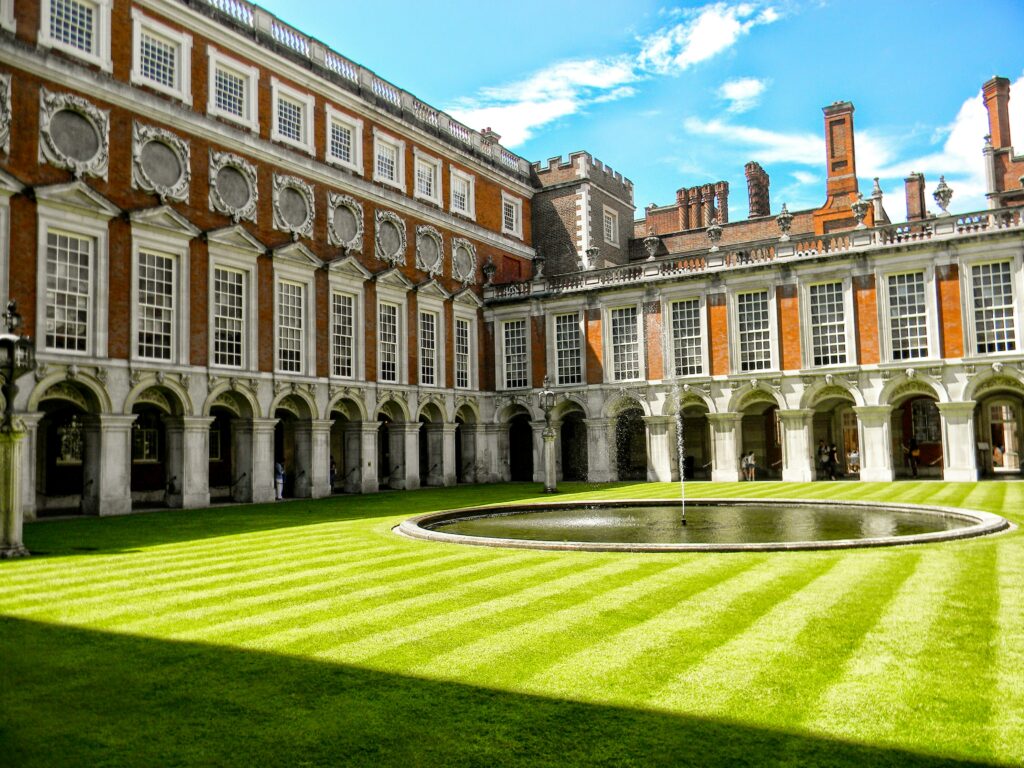
The ballrooms are buzzing, the gossip sheets are flying, and somewhere Lady Whistledown is sharpening her quill. Since Bridgerton swept onto Netflix screens in 2020, over 82 million households have been captivated by the Regency-era romance, scandal, and sumptuous settings. With Season 4 arriving in early 2026, there’s never been a better time to step into the world of the Ton. Here’s the thing that makes Bridgerton different from most period dramas: you can actually visit nearly every location. From the wisteria-draped Bridgerton family home to the ballrooms where Daphne and Simon danced, from the Featheringtons’ colourful townhouse to Queen Charlotte’s regal palace – these aren’t sets locked away in studios. They’re real English estates, museums, and historic sites scattered across England, many open to the public year-round. We’ve compiled the complete guide to every major Bridgerton filming location, with practical visiting information, insider tips, and details on how to plan your own Regency-era tour of England. Bath: The Heart of Bridgerton’s “London” Bath stands in for much of Regency London in Bridgerton, and honestly, it’s perfect casting. The UNESCO World Heritage city’s honey-coloured Georgian architecture and elegant crescents look like they were designed specifically for period dramas. Those pale limestone buildings you see throughout the series? That’s Bath stone, and it’s remarkably easy to spot once you know what you’re looking for. The very first scenes of Series 1 are three shots of Bath in the sunshine, setting the atmosphere for the entire show. You see elegant members of the ton promenading with parasols along Alfred Street, exchanging greetings on the Royal Crescent, and strolling down Bath Street between two colonnades. The city becomes a character itself. No. 1 Royal Crescent: The Featherington Family Home The most iconic location in Bath has to be No. 1 Royal Crescent, which serves as the exterior of the Featherington family home throughout all three seasons. In the show, this is their London townhouse in the fictional Grosvenor Square, but the real building is the first house in Bath’s most famous street, built between 1767 and 1775. The production team had some fun with this one. They added stone lions flanking the entrance, decorative pediments, and rosettes to reflect the Featherington family’s taste for opulence and their social-climbing aspirations. Through CGI magic, they made it appear as if the Bridgerton home sits directly opposite across a London square, though in reality, that’s Ranger’s House in Greenwich, over 100 miles away. Filming here takes about two to three days per series, and the Royal Crescent gets closed to traffic each time, generating enormous local interest. You can imagine the crowds gathering to watch the cast in full Regency costume climbing in and out of horse-drawn carriages. The beautiful news for visitors is that No. 1 Royal Crescent is now a museum, meticulously decorated and furnished as it would have been in the late 1700s. You can explore both the upstairs rooms where a Georgian family would have lived and the downstairs servants’ quarters, getting a genuine feel for Regency-era life. The museum even offers private Bridgerton-themed tours from £17 per person where guides share behind-the-scenes stories and production details. Just email them to book. The entire Royal Crescent itself is worth walking along. That sweeping curve of 30 Grade I listed terraced houses overlooking Royal Victoria Park is one of the finest examples of Georgian architecture in Britain, and you can wander freely across the lawn in front, imagining yourself promenading with the rest of high society. Abbey Green: Where Fashion and Gossip Collide Tucked away near Bath Abbey lies Abbey Green, a picturesque cobbled square with an irregular shape and a tree at its centre. This location was used heavily in Series 1 as the backdrop for shopping trips and strolls through London, often with added market stalls for atmosphere. The real gem here is The Abbey Deli, which was transformed into the Modiste dress shop owned by the infamous Madame Delacroix. The production team filmed both inside and outside this Grade II listed building with its traditional double-fronted bay windows. In the show, the Modiste is where the characters have their gowns fitted and where some of the juiciest gossip gets exchanged. Today, you can visit The Abbey Deli for coffee and sandwiches, and they’ve embraced their Bridgerton fame by selling themed merchandise alongside their regular offerings. It’s open daily, and there’s something rather delightful about having tea in the exact spot where Penelope and her sisters were fitted for ball gowns. The Assembly Rooms: Where the Ton Gathers Georgian Bath’s social epicentre was the Assembly Rooms, and Bridgerton made full use of these spectacular spaces. The Tea Room and Ball Room served as backdrops for the lavish ball scenes where characters dance under the watchful eye of society whilst The Ton passes judgement on every glance and gesture. Built in the 1770s for public social functions, the rooms were bombed during the Second World War and later rebuilt. What makes them special are the original Whitefriars crystal chandeliers that were actually lowered from the ceiling to feature more dramatically in the ballroom scenes. Imagine the logistics of that. The Assembly Rooms are owned by the National Trust and at the time of writing are closed for redevelopment, with plans to reopen as a tourist attraction in early 2027. Before then, they may open for limited visiting, so it’s worth checking the National Trust website if you’re planning a trip. The Holburne Museum: Lady Danbury’s Grand Mansion The impressive facade of the Holburne Museum serves as Lady Danbury’s residence in the series. This Grade I listed building was originally designed as a hotel in the late 19th century and is actually Bath’s first art gallery. The elegant exterior and gardens you see on screen are the real deal. The museum features prominently in Season 1, Episode 4, when Simon Basset attends a gathering hosted by Lady Danbury – a pivotal moment in his relationship with Daphne. In Season 3, Lady Danbury