
Easy Olive & Rosemary Focaccia Recipe
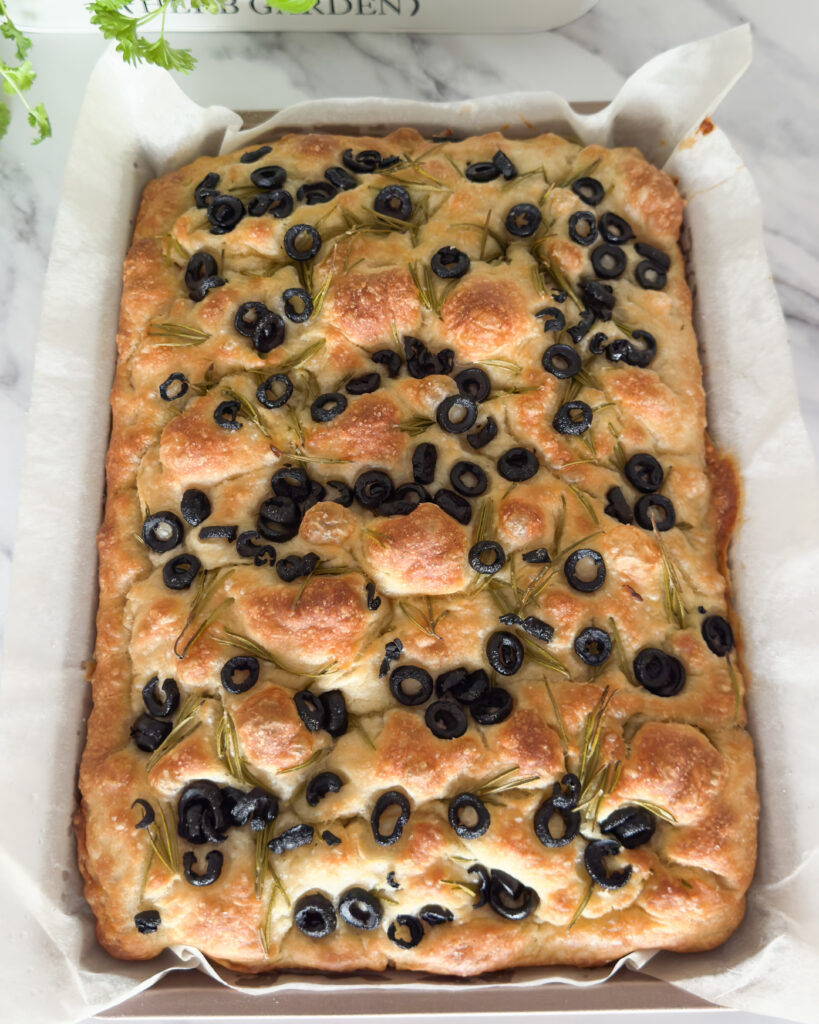
If you’ve been looking for an easy focaccia recipe that doesn’t need a stand mixer, hours of kneading, or any bread-baking experience at all, this is the one to bookmark. It’s soft and airy inside, deeply golden and crisp on top, and studded all over with salty olives, fresh rosemary and pools of good olive oil. Best of all, the whole thing comes together by hand in one bowl and you can eat it the same day. I make this focaccia on repeat, alongside a big bowl of salad, next to a platter of roasted vegetables, or torn straight from the tin while it’s still warm from the oven. It makes a kitchen smell like an Italian bakery, and it’s far more forgiving to make than you’d think. Why You’ll Love This Focaccia Recipe No stand mixer, no kneading. A few gentle stretch-and-folds do all the work. Deliberately wet dough. The high hydration is the secret to those big, irregular bubbles and a light, open crumb. Big on flavour. Fruity olive oil, briny olives and fresh rosemary in every bite. Great for sharing. One large tin feeds a crowd, and it’s ideal for slicing up for lunch, snacking, or serving alongside dinner. Freezer-friendly. Make a batch and freeze the extra for busy weeks. A Little History of Focaccia Focaccia is one of the oldest breads in Italy, with roots stretching back to the Ligurian coast around Genoa. Its name comes from the Latin panis focacius — bread baked on the hearth, or focus — a nod to how Etruscan and Roman bakers once cooked flatbreads directly on hot stones or embers, long before ovens as we know them existed. Over the centuries, every Italian region shaped it in its own way. In Liguria, focaccia is thin, dimpled and glossy with olive oil, traditionally dipped into a morning cappuccino. Head south to Puglia and it turns thicker and softer, topped with tomatoes and oregano. In Recco, near Genoa, there’s even a version stuffed with soft cheese instead of toppings altogether. This recipe leans closer to the Ligurian style — olive oil-rich, deeply dimpled, and topped simply so the bread itself gets to be the main event. Adding olives and rosemary is my own spin, inspired by the version I keep coming back to on every trip to Italy. Ingredients for Olive & Rosemary Focaccia Here’s what you’ll need to make this recipe, along with a few notes on each. Plain flour – no need for strong bread flour here; plain flour gives a lovely soft, tender crumb. Warm water – this is a high-hydration dough, which is what makes it so soft and bubbly. Don’t be tempted to add extra flour to make it easier to handle. Fast-action dried yeast – no proofing required beyond the initial 5-minute rest with the water and sugar. Caster sugar – just a touch, to help the yeast get going. Fine sea salt – for the dough itself. Extra virgin olive oil – used three ways: in the dough, in the tin, and drizzled on top. Use a bottle you’d happily drizzle over a salad, as the flavour really comes through. Olives – green, Kalamata, or a mixture of both work beautifully. Just make sure they’re well drained so they don’t add excess moisture to the dough. Fresh rosemary – roughly chopped, so you get little bursts of it throughout. Flaky sea salt – for topping, once the focaccia comes out of the oven’s dimples and before it goes into the oven. How Focaccia Actually Comes Together This isn’t a bread that asks much of you, but it helps to understand why each stage matters before you get started — that way you’ll know exactly what you’re looking for at every point. The yeast mixture should look alive before you carry on. Warm water, a pinch of sugar and the yeast need about 5 minutes together. You’re looking for a light foam on the surface — that’s your sign the yeast is active. If nothing happens after 10 minutes, your water was likely too hot or too cold, and it’s worth starting again rather than pushing on with a dead mixture. The dough is meant to look wrong. Once the flour and salt go in, you’ll end up with something closer to a thick batter than a dough. This is a high-hydration recipe, and that wetness is exactly what gives focaccia its open, bubbly crumb — resist any urge to work in extra flour. Folding replaces kneading entirely. Rather than working the dough on a surface, you’ll fold it inside the bowl with wet or oiled hands, lifting one edge up and over into the middle, then rotating and repeating. Two short rounds of this, with a brief rest in between, is enough to build all the structure this loaf needs. Give the first prove real time. An hour to ninety minutes in a warm spot lets the dough double and develop those large, irregular air pockets. A cooler kitchen will simply take longer — don’t rush it by turning up the heat, or you’ll lose the slow fermentation flavour. Oil is doing double duty in the tin. A generous layer across the base stops the dough sticking and helps the underside crisp and caramelise as it bakes, almost like shallow-frying the bottom of the loaf. Stretch gently, and let the dough tell you when it’s ready. Once it’s in the tin, coax it towards the corners with oiled fingertips. If it keeps springing back, that’s the gluten telling you it needs a short rest — five to ten minutes usually does it. The second prove is shorter but just as important. Forty to fifty minutes gives you a visibly puffed, pillowy dough. Skip this step and you’ll end up with a denser, flatter bake. Dimpling is where the character comes from. Press your fingertips firmly all the way down to the base of the tin — this is what creates focaccia’s signature craggy