The ballrooms are buzzing, the gossip sheets are flying, and somewhere Lady Whistledown is sharpening her quill. Since Bridgerton swept onto Netflix screens in 2020, over 82 million households have been captivated by the Regency-era romance, scandal, and sumptuous settings. With Season 4 arriving in early 2026, there’s never been a better time to step into the world of the Ton.
Here’s the thing that makes Bridgerton different from most period dramas: you can actually visit nearly every location. From the wisteria-draped Bridgerton family home to the ballrooms where Daphne and Simon danced, from the Featheringtons’ colourful townhouse to Queen Charlotte’s regal palace – these aren’t sets locked away in studios. They’re real English estates, museums, and historic sites scattered across England, many open to the public year-round.
We’ve compiled the complete guide to every major Bridgerton filming location, with practical visiting information, insider tips, and details on how to plan your own Regency-era tour of England.
Bath: The Heart of Bridgerton’s “London”
Bath stands in for much of Regency London in Bridgerton, and honestly, it’s perfect casting. The UNESCO World Heritage city’s honey-coloured Georgian architecture and elegant crescents look like they were designed specifically for period dramas. Those pale limestone buildings you see throughout the series? That’s Bath stone, and it’s remarkably easy to spot once you know what you’re looking for.
The very first scenes of Series 1 are three shots of Bath in the sunshine, setting the atmosphere for the entire show. You see elegant members of the ton promenading with parasols along Alfred Street, exchanging greetings on the Royal Crescent, and strolling down Bath Street between two colonnades. The city becomes a character itself.
No. 1 Royal Crescent: The Featherington Family Home
The most iconic location in Bath has to be No. 1 Royal Crescent, which serves as the exterior of the Featherington family home throughout all three seasons. In the show, this is their London townhouse in the fictional Grosvenor Square, but the real building is the first house in Bath’s most famous street, built between 1767 and 1775.
The production team had some fun with this one. They added stone lions flanking the entrance, decorative pediments, and rosettes to reflect the Featherington family’s taste for opulence and their social-climbing aspirations. Through CGI magic, they made it appear as if the Bridgerton home sits directly opposite across a London square, though in reality, that’s Ranger’s House in Greenwich, over 100 miles away.
Filming here takes about two to three days per series, and the Royal Crescent gets closed to traffic each time, generating enormous local interest. You can imagine the crowds gathering to watch the cast in full Regency costume climbing in and out of horse-drawn carriages.
The beautiful news for visitors is that No. 1 Royal Crescent is now a museum, meticulously decorated and furnished as it would have been in the late 1700s. You can explore both the upstairs rooms where a Georgian family would have lived and the downstairs servants’ quarters, getting a genuine feel for Regency-era life. The museum even offers private Bridgerton-themed tours from £17 per person where guides share behind-the-scenes stories and production details. Just email them to book.
The entire Royal Crescent itself is worth walking along. That sweeping curve of 30 Grade I listed terraced houses overlooking Royal Victoria Park is one of the finest examples of Georgian architecture in Britain, and you can wander freely across the lawn in front, imagining yourself promenading with the rest of high society.
Abbey Green: Where Fashion and Gossip Collide
Tucked away near Bath Abbey lies Abbey Green, a picturesque cobbled square with an irregular shape and a tree at its centre. This location was used heavily in Series 1 as the backdrop for shopping trips and strolls through London, often with added market stalls for atmosphere.
The real gem here is The Abbey Deli, which was transformed into the Modiste dress shop owned by the infamous Madame Delacroix. The production team filmed both inside and outside this Grade II listed building with its traditional double-fronted bay windows. In the show, the Modiste is where the characters have their gowns fitted and where some of the juiciest gossip gets exchanged.
Today, you can visit The Abbey Deli for coffee and sandwiches, and they’ve embraced their Bridgerton fame by selling themed merchandise alongside their regular offerings. It’s open daily, and there’s something rather delightful about having tea in the exact spot where Penelope and her sisters were fitted for ball gowns.
The Assembly Rooms: Where the Ton Gathers
Georgian Bath’s social epicentre was the Assembly Rooms, and Bridgerton made full use of these spectacular spaces. The Tea Room and Ball Room served as backdrops for the lavish ball scenes where characters dance under the watchful eye of society whilst The Ton passes judgement on every glance and gesture.
Built in the 1770s for public social functions, the rooms were bombed during the Second World War and later rebuilt. What makes them special are the original Whitefriars crystal chandeliers that were actually lowered from the ceiling to feature more dramatically in the ballroom scenes. Imagine the logistics of that.
The Assembly Rooms are owned by the National Trust and at the time of writing are closed for redevelopment, with plans to reopen as a tourist attraction in early 2027. Before then, they may open for limited visiting, so it’s worth checking the National Trust website if you’re planning a trip.
The Holburne Museum: Lady Danbury’s Grand Mansion
The impressive facade of the Holburne Museum serves as Lady Danbury’s residence in the series. This Grade I listed building was originally designed as a hotel in the late 19th century and is actually Bath’s first art gallery. The elegant exterior and gardens you see on screen are the real deal.
The museum features prominently in Season 1, Episode 4, when Simon Basset attends a gathering hosted by Lady Danbury – a pivotal moment in his relationship with Daphne. In Season 3, Lady Danbury hosts her Four Seasons Ball here, and the building looks absolutely spectacular all dressed up for filming.
The good news is you can visit and explore the permanent collection of fine and decorative art from Britain and beyond. Even better, there’s a new ‘Walking in the footsteps of Queen Charlotte’ tour planned for 2025, featuring costumed characters leading visitors through the museum and the adjacent Sydney Gardens. You can even see a portrait of the actual Queen Charlotte inside.
Bath Street and Beyond
Bath Street appears in multiple street scenes across all seasons, and it’s easy to see why. This short but grand street features a row of colonnades on each side and leads to an ornamental structure housing the Cross Bath, one of Bath’s historic hot thermal baths. The cobblestones and Georgian architecture create the perfect Regency backdrop.
Beaufort Square, a small garden behind the Theatre Royal Bath, is where Eloise and Penelope have that intense conversation about Marina’s pregnancy in Season 1. Just next door on Trim Street is where Simon and Daphne meet in Season 1, Episode 3, at what the show presents as Gunter’s Tea Shop – a real Regency-era London hotspot.
All of these locations are public streets and squares that you can wander freely, which makes Bath the perfect city for a self-guided Bridgerton tour. The honey-coloured stone, the elegant proportions, the way the light catches the buildings – it all combines to create that Regency atmosphere even without the costumes and carriages.
Greenwich: Where the Bridgertons Actually Live
While Bath provides Bridgerton’s London streets, Greenwich gives us the actual homes. The contrast is interesting – Bath’s warm honey stone versus Greenwich’s darker brick and Portland stone – but clever editing makes them feel like the same city.
Ranger’s House: The Wisteria-Clad Dream
The exterior shots of the Bridgerton family home are filmed at Ranger’s House, a red-brick Georgian villa sitting on the boundary between Greenwich Park and Blackheath. Built in 1723, it’s spent centuries housing aristocrats and royals, including Princess Augusta, sister of King George III. These days it’s home to the Wernher Collection – over 700 pieces of art including Renaissance jewellery, medieval ivory, and Dutch Old Master paintings.
The production team’s transformation of Ranger’s House is where things get interesting. That romantic cascade of wisteria you see draping the facade? Some of it’s real climbing plants they encouraged to grow, some of it’s artificial additions, and quite a bit is CGI enhancement. The ivy covering parts of the building was similarly augmented to create that established, slightly wild romantic look that says “old money” rather than “trying too hard.”
What you won’t see at Ranger’s House are the interiors. That famous blue-and-white Bridgerton drawing room, the grand entrance hall with the sweeping staircase, the family dining room – none of those are here. Those were all filmed at RAF Halton in Buckinghamshire, which unfortunately is an active military base and completely off-limits to visitors.
The house is managed by English Heritage and opens to visitors on selected days, typically Wednesday to Sunday during the summer months (April to October), though this can vary. Entry costs around £10.70 for adults, and you’ll need about 45 minutes to an hour to see the collection properly. It’s worth checking the English Heritage website before making a special trip, as opening times are quite limited.
The real draw here for Bridgerton fans is standing in front of that facade, imagining the family inside preparing for yet another ball or recovering from yet another scandal. Walk around to the side where the servants’ entrance would have been, wander through the small gardens, and you start to understand how these grand houses actually functioned.
Old Royal Naval College: London’s Streets
If you’re wondering where all those London street scenes were filmed – the ones where characters are distributing Lady Whistledown’s scandal sheets, meeting in courtyards, or rushing to appointments – many of them are at the Old Royal Naval College in Greenwich.
These magnificent Baroque buildings designed by Christopher Wren sit right on the Thames, and they’ve become one of Britain’s most filmed locations for good reason. The Grand Square with its symmetrical colonnades, the covered walkways, the classical proportions – it all reads as grand London without requiring any digital trickery to remove modern elements.
The buildings appear throughout all three series of Bridgerton plus the Queen Charlotte spin-off. That scene where Eloise and Penelope walk through the market whilst young boys hand out the latest Lady Whistledown dispatch? Filmed here. The courtyard scenes, the walking and talking moments, the establishing shots of characters arriving at various London destinations – the Old Royal Naval College provides the backdrop.
The site is free to walk around, which makes it perfect for Bridgerton pilgrims on a budget. The grounds are open daily from 10am to 5pm, and you can wander the Grand Square, walk under the colonnades, and generally recreate your favourite walking-and-talking scenes without spending a penny.
What you should absolutely not skip, however, is the Painted Hall. This isn’t a Bridgerton location, but it’s genuinely one of the most spectacular interiors in Britain – a Baroque masterpiece that took 19 years to paint and really does deserve its nickname as “the Sistine Chapel of the UK.” Entry is £12.50 for adults and includes the Chapel. Given that you’re already at a major Bridgerton filming location, it seems silly not to see the main attraction.
The whole Greenwich area works beautifully as a half-day Bridgerton excursion. Start at Ranger’s House, walk down through Greenwich Park (which is lovely and free), emerge at the Old Royal Naval College, explore the Painted Hall, then reward yourself with lunch in Greenwich’s market or by the river. It’s a proper day out that happens to include Bridgerton locations rather than being just a filming location tick-box exercise.
The Country Houses: Where Things Get Complicated
The stately homes used in Bridgerton present an interesting challenge for visitors. Some are major tourist attractions you can explore freely. Others are National Trust properties with seasonal opening. A few are private estates that you simply cannot visit. Here’s what you need to know about the ones that matter most.
Castle Howard: The Duke’s Magnificent Pile
If you only visit one Bridgerton country house, make it Castle Howard. This is Clyvedon Castle, the Duke of Hastings’ ancestral home, and it’s every bit as spectacular in real life as it appears on screen.
Located in the Yorkshire countryside near York, Castle Howard took over 100 years to build – work began in 1699 and wasn’t completed until 1811. Three Earls’ lifetimes went into creating this Baroque masterpiece with its symmetrical wings and crowning dome. Today it’s still owned by the Howard family, but they’ve opened it to visitors, and frankly, it’s one of the finest stately homes in England.
Bridgerton filmed in multiple rooms here for Season 1. The Turquoise Room, where Simon and Daphne have some of their most intense conversations. The Long Gallery, stretching seemingly forever with its painted ceiling and family portraits. The Garden Room, which becomes their marital bedroom in Episode 6 – where Daphne learns why Simon refuses to have children. The Antique Passage. Each room is more impressive than the last, and they’re all part of the standard house tour.
Entry costs £23 for house and grounds, or £15 for grounds only if you’re watching your budget. You genuinely need a half-day here, possibly a full day if you want to explore the extensive grounds properly. There are temples tucked into the woodland, a walled rose garden, a Great Lake where you can take boat trips, and enough walking trails to wear out the most energetic visitors.
The house is open year-round, though the grand rooms are only accessible March to October. The grounds stay open all winter, which has its own appeal – imagine Clyvedon Castle in the mist and rain, very Gothic, very atmospheric. There’s nowhere to stay on the estate itself, but York is only 15 miles away and makes an excellent base with proper hotels, restaurants, and the bonus of being a beautiful historic city in its own right.
Getting there without a car is possible but not straightforward – you’d take the train to York, then a bus or taxi to Castle Howard. Most visitors drive, and it’s about 4 hours from London, 1 hour from Leeds or Manchester. Worth every minute of the journey.
Wilton House: The Interior Workhorse
Here’s something most Bridgerton fans don’t realise: many of the grand interior scenes across all three seasons were filmed at the same place. Wilton House in Wiltshire has been standing in for multiple different buildings, and if you visit, you’ll experience that slightly surreal moment of recognising rooms you thought were in completely different houses.
This is where Queen Charlotte’s throne room was filmed. Also the Duke of Hastings’ dining hall. Also various other grand reception rooms, galleries, and formal spaces across the series. The production team relies on Wilton House because it’s cooperative with filming, has spectacular state rooms, and the interiors are so varied that they can convincingly represent different buildings.
The house has been the seat of the Earls of Pembroke for over 450 years, though the current building dates from the 1630s, designed partially by Inigo Jones. The Double Cube Room is particularly famous – perfectly proportioned with painted ceilings and hung with Van Dyck portraits. It’s appeared in everything from The Crown to Pride and Prejudice to Emma, and yes, you’ll recognise it from Bridgerton too.
Wilton House opens to visitors from Easter to early September, typically Thursday to Sunday, though this varies so checking ahead is essential. Entry costs £19 for adults, £10 for children, and you’ll want at least 2-3 hours to see the house properly. The estate also has riverside walks, a huge adventure playground (excellent if you’re bringing children), and a café.
It’s located just outside Salisbury, which is 1.5 hours by train from London Waterloo. From Salisbury station you’ll need a bus or taxi (2 miles), but it’s an easy addition to a day that also includes Salisbury Cathedral, Stonehenge if you’re feeling ambitious, or just exploring the medieval city centre.
Hatfield House: The Jacobean Gem
Hatfield House in Hertfordshire is where Queen Elizabeth I spent much of her childhood, which gives you some idea of its historical pedigree. The current Jacobean house was built in 1611 and it’s remained remarkably intact, which makes it perfect for period drama filming.
Bridgerton uses Hatfield House extensively for interiors – it’s stood in for the Bridgerton house in Season 2, various rooms in the Featherington residence across multiple seasons, and other grand interior scenes. The state rooms are spectacular, particularly the Marble Hall and the Grand Staircase. The Chinese bedroom is almost absurdly opulent, with its silk wallpaper and elaborate four-poster bed that was supposedly reserved exclusively for visits by the King of England.
What makes Hatfield particularly visitor-friendly is that it’s been welcoming tourists for decades and has excellent facilities. The house opens March to September on selected days (typically Wednesday, Thursday, Saturday, and Sunday, though this can vary). Entry costs £20 for house and gardens, or £12 for gardens only. You’ll want 3-4 hours here to do it justice.
The location is brilliantly convenient if you’re staying in London. Hatfield station is just 25 minutes from King’s Cross on the train, then a 10-minute walk to the house. No car needed, which makes it an easy day trip. The estate also hosts events throughout the summer – open-air cinema, living history days, food festivals – so it’s worth checking what’s on when you visit.
The gardens are lovely too, with parterre gardens, woodland walks, and that very English combination of formal and informal that makes you understand why period dramas love filming here. There’s been some criticism that locations like Hatfield are “too perfect” for representing real Regency-era homes, but honestly, perfection isn’t a bad thing when you’re paying £20 to visit.
The Locations You Cannot Visit
It seems only fair to be upfront about the Bridgerton locations that are off-limits, saving you from planning trips to places that won’t let you through the door.
RAF Halton: The Bridgerton House Interiors
Remember that gorgeous blue-and-white drawing room? The grand entrance hall where the family gathers? The sweeping staircase? All of those interiors are at RAF Halton in Buckinghamshire, specifically in the Officers’ Mess building known as Halton House.
RAF Halton is one of the UK’s largest Royal Air Force stations, home to approximately 2,100 military personnel. It’s been operational since World War I and shows no signs of closing (well, until 2027 when it’s scheduled to shut down, but that doesn’t help Bridgerton fans now). The buildings are used daily for military operations and training, and there is absolutely no public access.
The BBC occasionally films inside for documentaries about RAF training, so you might catch glimpses of the building that way, but you’re not going to tour it. The best you can do is drive past the entrance if you’re really determined, but security means you won’t see much beyond the gates.
The production team chose Halton House because those interiors are genuinely spectacular – grand staircases, elaborate plasterwork, rooms that photograph beautifully. But its military status means it remains firmly closed to curious fans.
Wrotham Park: Aubrey Hall
This one hurts because Aubrey Hall is such a significant location in the series – it’s the Bridgerton family’s country estate where so many important scenes take place. The pall-mall games on the lawn. Anthony’s proposal to Edwina. Family gatherings. Romantic tension in every corner of the grounds.
The real location is Wrotham Park in Hertfordshire, a Palladian mansion built in 1754 and set in a 2,500-acre estate. It’s stunning, it’s perfectly preserved, and it’s completely private. The estate is only available for exclusive hire – weddings, corporate events, film locations – at prices that put it well beyond a casual visit.
You can drive past if you’re in the area (it’s near Potters Bar), but you can’t access the grounds or get close to the house. The best consolation is that several other stately homes in this guide – Castle Howard, Basildon Park, Wilton House – offer similar experiences of grand country estates, even if they’re not the actual Aubrey Hall.
Lancaster House: Queen Charlotte’s Palace
Lancaster House in Westminster, just off The Mall, provides most of the interior filming for Queen Charlotte’s palace – her private apartments, drawing rooms, music room, the works. Built in 1825 for the Duke of York, it’s now used by the government for official receptions and functions.
The building occasionally opens to the public during Open House London weekend in September, but that’s one weekend per year and places are limited. Otherwise, it’s a look-but-don’t-touch situation. You can walk past on Stable Yard and admire the exterior, which is impressive in that grand London mansion style, but you’re not getting inside unless you’re attending a government function.
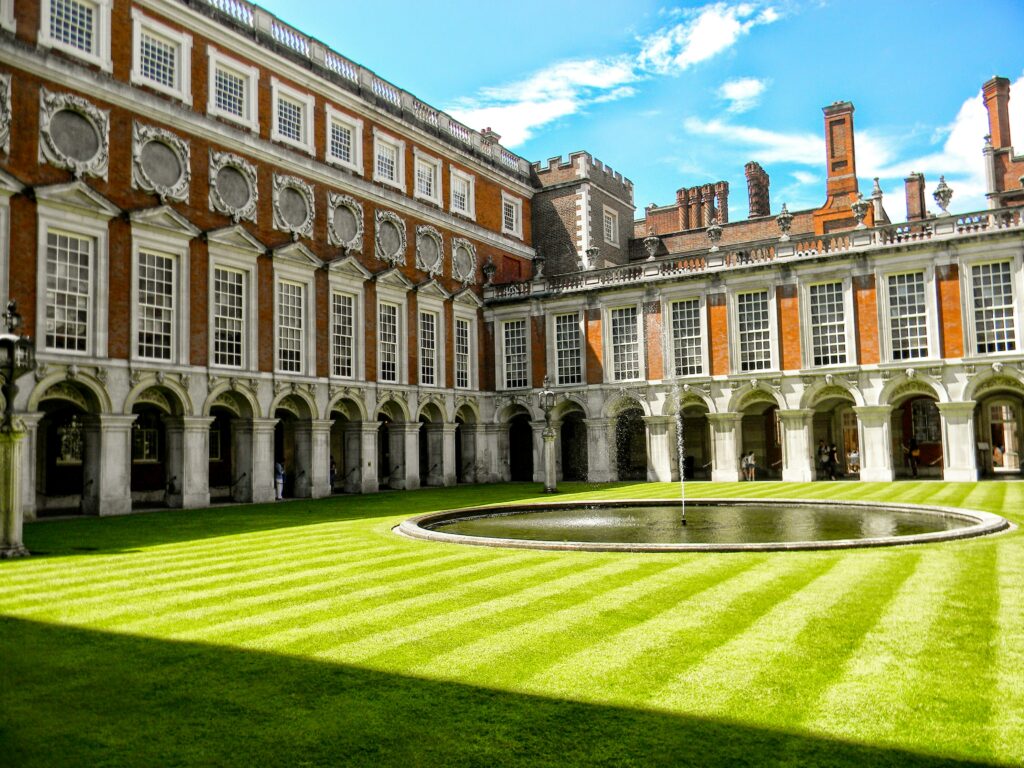
The good news is that Hampton Court Palace, which provides the exterior shots of Queen Charlotte’s residence, is absolutely open to visitors and is magnificent. So you get the outside even if the inside remains tantalizingly off-limits.
The Surprising Locations
Some Bridgerton filming locations are unexpected, tucked away in places you wouldn’t necessarily think to look. These are worth knowing about if you’re already in the area or if you’re the completist type who wants to tick off every possible location.
Painshill Park: More Than Just a Pretty Backdrop
Painshill Park in Surrey has appeared across all three seasons of Bridgerton in various guises, which speaks to how versatile this 158-acre landscaped garden actually is. Season 1 used it for the Featherington family picnic, for courting scenes, and most memorably for that conversation between Daphne and Simon on the Five Arch Bridge.
Season 3 gives it a bigger role as the location for Lord Hawkins’ hot air balloon demonstration, using the valley next to the lake because it’s “a great big bowl where we can throw a camera around 360 degrees” with no modern buildings visible, according to location manager Tony Hood.
Created in the 18th century, Painshill was one of the finest landscape gardens of its era, complete with a Gothic temple, a Chinese bridge, a crystal grotto, and various other follies scattered across the grounds. It fell into disrepair in the 20th century and has been gradually restored by volunteers since the 1980s. Today it’s managed by a trust and open to visitors for £9.50.
The park is genuinely lovely for a Sunday walk, Bridgerton connection aside. The landscaping was designed to lead you through a series of “surprises” – you round a corner and suddenly there’s a temple, or you descend a path and find yourself at the grotto entrance. It’s the kind of place where you can imagine Regency-era visitors promenading and being suitably impressed by nature “improved” by human design.
Getting there requires either driving (it’s 45 minutes from London) or taking the train to Cobham & Stoke D’Abernon station and walking 25 minutes. Opening hours are April to October daily, November to March weekends only, so plan accordingly.
Osterley Park: The Grand Outdoor Ball
Osterley Park appears in Season 3 as the setting for a spectacular outdoor ball scene. This National Trust property in west London is a neo-classical house designed by Robert Adam in the 1760s, set in parkland where cattle still graze. That juxtaposition of grand architecture and working farmland is very English and very Bridgerton.
The house itself is impressive – Adam’s interiors are considered some of his finest work – but for Bridgerton, it’s the grounds that matter. The formal areas nearest the house, the sweeping lawn, the way the building sits in its landscape – it all photographs beautifully and provides that sense of space and grandeur that balls require.
What makes Osterley particularly accessible is that it’s right on the Piccadilly tube line. Osterley station to the park entrance is a 10-minute walk, meaning you can visit from central London without a car. The park is free to access, though house entry costs £12.50 for non-National Trust members.
The house is open March to October, Wednesday to Sunday, though the park is open daily all year. If you’re a London resident looking for a Bridgerton location that doesn’t require a day trip to Bath or Yorkshire, this is probably your best bet after Greenwich.
Practical Planning: Creating Your Bridgerton Tour
One Day – London & Greenwich Focus
Morning: Ranger’s House (Bridgerton exterior), walk through Greenwich Park to Old Royal Naval College and Painted Hall Afternoon: Queen’s House (free), lunch in Greenwich Evening: Return to central London via riverboat (atmospheric approach)
Budget: £25-35 per person plus meals
One Day – Bath Focus
Morning: Royal Crescent and No.1 Royal Crescent museum Mid-morning: Walk to Assembly Rooms, then Holburne Museum Lunch: Near Abbey Green Afternoon: Abbey Green and The Abbey Deli (Modiste), walk Bath Street and other street locations Late afternoon: Bath Abbey area
Budget: £25-40 per person plus meals
Two Days – Greatest Hits
Day 1 – Bath: Follow one-day Bath itinerary above Day 2 – London/Windsor: Greenwich morning (Ranger’s House, Naval College), afternoon at Windsor Great Park or Hampton Court Palace
Budget: £60-90 per person plus accommodation and meals
Four Days – Comprehensive Tour
Day 1: Bath (full day) Day 2: Greenwich and London locations Day 3: Castle Howard (requires full day with travel from London) Day 4: Wilton House and Salisbury, or Blenheim Palace and Oxford
Budget: £150-250 per person plus accommodation, meals, transport
Weekend – Stately Homes Tour (Driving Required)
Saturday: Hatfield House (morning/lunch), Basildon Park (afternoon) Sunday: Blenheim Palace (full day) or Castle Howard if you’re starting from the North
Budget: £70-100 per person plus accommodation, meals, petrol
Money-Saving Tips
National Trust Membership: If visiting multiple National Trust properties (Basildon Park, Belton House, Stowe Gardens, Osterley Park, Claydon House), annual membership (£84 per year) pays for itself after about 6-7 visits.
English Heritage Membership: Covers Ranger’s House. Worth it if visiting multiple English Heritage sites (£60 per year).
Advance booking: Most major attractions (Hampton Court, Blenheim, Castle Howard) are cheaper when booked online in advance.
Free locations: Royal Crescent exterior, Bath streets, Greenwich Park, Windsor Great Park, Old Royal Naval College grounds are all free.
Season-by-Season Filming Locations
Season 1 Highlights
Key locations: Castle Howard (Clyvedon), Bath streets, Wilton House interiors, Ranger’s House, Painshill Park, Stowe Gardens
Most recognisable scenes: The Duke’s stately home, London street scenes, garden promenades, ball scenes
Season 2 Highlights
Key locations: Wrotham Park (Aubrey Hall), Windsor Great Park, Basildon Park, Hatfield House, Hampton Court
Most recognisable scenes: Aubrey Hall exterior and grounds, pall-mall games, Kate and Anthony in the rain
Season 3 Highlights
New locations: Grimsthorpe Castle, Claydon House, Squerryes Court, Kingston Bagpuize House Returning locations: Basildon Park (new purpose), Blenheim Palace, Painshill Park
Most recognisable scenes: Colin and Penelope’s first kiss (Basildon gardens), hot air balloon event, Innovation Ball
Frequently Asked Questions
Can you visit the actual Bridgerton house? The exterior (Ranger’s House, Greenwich) yes. The interiors (RAF Halton) no – it’s an active air force base.
Is Grosvenor Square used in filming? No. Despite being mentioned in the show as where the Bridgertons live, the real Grosvenor Square in London is not used. Bath’s Royal Crescent and Greenwich locations stand in for Mayfair.
Which location is most worth visiting? Depends on your interests, but Castle Howard offers the most “wow” factor, Bath gives you the most recognisable street scenes, and Greenwich provides the most accessible cluster of locations.
Do you need a car? Not for London and Bath. Essential for: Castle Howard, Wrotham Park area, Grimsthorpe Castle, most stately homes in countryside locations.
How much time do I need? Minimum one full day for either Bath or London/Greenwich. Ideally 3-4 days for a proper tour including countryside locations.
Best time to visit? April-October for maximum opening hours. September is ideal – good weather, fewer crowds, everything still open.
Are there guided tours? Yes:
- Bath has official Bridgerton walking tours
- Some locations offer guided house tours
- Private tour companies offer Bridgerton-themed days
- Self-guided is perfectly feasible with this guide
Final Thoughts: Is a Bridgerton Tour Worth It?
Here’s my honest take after researching and visiting many of these locations: if you’re a genuine Bridgerton fan and you appreciate historic houses and Georgian architecture, absolutely yes. Britain’s stately homes are spectacular regardless of their television connections, and seeing them through the Bridgerton lens adds an extra layer of enjoyment.
However, if you’re expecting to walk onto actual film sets or have immersive Bridgerton experiences at every location, temper your expectations. Most locations are beautiful historic properties that happened to be used for filming. The Bridgerton connection is often just that – a connection, not a theme park experience.
The exceptions are Bath (where you genuinely walk the same streets you see on screen) and No.1 Royal Crescent (which offers Bridgerton-themed tours). Castle Howard lets you see the actual rooms where Simon and Daphne’s scenes were filmed. These three offer the most satisfying Bridgerton fan experiences.
The real value of a Bridgerton tour is that it takes you to some of Britain’s most beautiful locations – houses, parks, and cities you should visit anyway. The show is your excuse and your guide, but the destinations themselves justify the journey.
And honestly, there’s something magical about standing in the same Georgian drawing room or walking through the same formal gardens you’ve watched your favourite characters navigate on screen. It connects you to the show in a way that photographs never quite can.
So yes, plan your Bridgerton tour. Visit Bath’s golden streets. Walk through Greenwich Park to Ranger’s House. Stand in Castle Howard’s Long Gallery. Explore Blenheim’s state rooms. These places tell Britain’s story – and now they’re part of Bridgerton’s story too.
Just book ahead, check opening times, allow more time than you think you need, and remember that half the joy is in the journey between locations. Britain’s countryside between these grand houses is pretty spectacular in its own right.