The Romantic Road (Romantische Straße) is Germany’s most famous scenic route, and for good reason. This 400km journey through Bavaria takes you past fairy-tale castles, perfectly preserved medieval towns, baroque palaces, rolling vineyards, and eventually into the dramatic foothills of the Alps.
It’s a route that rewards slow travel – lingering in cobbled squares, walking ancient town walls, discovering hidden churches, and watching the landscape shift from Franconian wine country to Alpine peaks. Whether you’re driving, cycling, or taking the train, the Romantic Road offers some of the most beautiful and romantic scenery in southern Germany.
This guide covers the route’s highlights, the best castles and towns to visit, what makes the countryside so special, and how to experience it all at your own pace.
What Is the Romantic Road?
The Romantic Road runs approximately 400km from Würzburg in northern Bavaria to Füssen in the south, passing through Franconia and Upper Bavaria. Created as a designated tourist route in the 1950s, it links some of Germany’s most beautiful medieval towns, baroque churches, and historic castles.
The name ‘Romantische Straße’ refers to the medieval, romantic-era character of the towns along the route rather than modern romance – though the scenery certainly inspires that too. As you travel south, the landscape transforms from gentle vineyard-covered hills around Würzburg to the dramatic mountain backdrop of Füssen and the Alps.
The route is dotted with around 28 official stops, though you don’t need to visit them all. The real magic is in selecting the towns and castles that appeal most to you and taking time to explore them thoroughly rather than rushing through.
The Northern Section: Würzburg to Rothenburg
Würzburg: Baroque Splendour & Wine Culture
The Romantic Road begins in Würzburg, a beautiful baroque city on the Main River surrounded by vineyard-covered hills. This is proper wine country, and the city has a sophistication and energy that sets it apart from the smaller towns further south.
The Würzburg Residenz is the star attraction – a UNESCO World Heritage palace that ranks among Europe’s finest baroque buildings. The grand staircase, designed by Balthasar Neumann, is topped by the world’s largest ceiling fresco, painted by Giovanni Battista Tiepolo. The Court Garden behind the palace is equally impressive, with manicured lawns, fountains, and sculptures.
Walk across the Old Main Bridge for views over the river and the Marienberg Fortress on the hill above. The bridge is lined with statues of saints and is a favourite spot for locals to gather with wine from the surrounding vineyards.
Marienberg Fortress sits on a hill overlooking the city. You can walk up (steep but rewarding) or take a bus. The fortress itself houses museums, but the real draw is the panoramic view over Würzburg’s terracotta rooftops, the river, and the vineyards beyond.
The countryside around Würzburg is characterised by gentle hills covered in Franconian vineyards. If you’re driving, consider taking a detour through the wine villages – places like Sommerhausen and Ochsenfurt are beautiful and far less touristy.
Weikersheim Palace
About 40km south of Würzburg, Weikersheim Palace is often overlooked but absolutely worth visiting. This Renaissance palace has beautifully preserved interiors and one of Germany’s finest baroque gardens – a formal layout with geometric patterns, sculptures, and perfectly trimmed hedges that stretch out towards the Tauber Valley.
The palace sits in a small, quiet town, so you can wander the gardens and halls without the crowds you’ll encounter at more famous stops.
Röttingen & the Tauber Valley
As you continue south, the route follows the Tauber River through a landscape of gentle hills, forests, and small farming villages. The valley is particularly beautiful in late spring when everything is green, and in autumn when the vines turn gold and red.
Röttingen is a tiny walled town that most people drive straight past. If you have time, stop for half an hour – the medieval walls are intact, the streets are peaceful, and it feels refreshingly uncommercial.
Creglingen: Herrgottskirche
Just off the main route near Creglingen, the Herrgottskirche (Lord God’s Church) houses one of the masterpieces of medieval German art: Tilman Riemenschneider’s carved wooden altarpiece. The church itself is small and unassuming from the outside, but the altar inside – depicting the Assumption of Mary – is extraordinarily detailed and moving.
It’s a quiet, contemplative stop that offers something different from the bustle of the larger towns.
Rothenburg ob der Tauber: The Jewel of the Romantic Road
Rothenburg is the Romantic Road’s most famous town, and it lives up to its reputation. This is the medieval Germany of imagination – a near-perfectly preserved walled town with towers, cobbled streets, half-timbered houses painted in warm colours, and market squares that look like film sets.
The town sits on a plateau above the Tauber Valley, and the setting is as beautiful as the architecture. You can walk almost the entire circuit of the medieval walls – about 2.5km – with covered walkways, towers, and views over the valley and surrounding countryside.
The Plönlein is Rothenburg’s most photographed corner – a Y-shaped junction where two streets meet, framed by half-timbered houses and towers. It’s impossibly picturesque, especially early in the morning before the crowds arrive.
St. Jakob’s Church contains another Riemenschneider masterpiece – the Holy Blood Altar, an intricately carved altarpiece depicting the Last Supper.
The town gets extremely busy between 10am and 4pm when day-trippers and tour groups arrive. If you can, stay overnight. The town empties out in the evening, and walking the quiet streets at dusk or dawn – when the light is soft and golden – is magical.
The countryside around Rothenburg is rolling farmland and forest, with paths leading down into the Tauber Valley. If you have time, walk down to the Doppelbrücke (Double Bridge) – a short trail from the town that offers beautiful views back up towards Rothenburg’s walls and towers.
The Central Section: Medieval Towns & Open Countryside
Dinkelsbühl: Quieter Charm
About 40km south of Rothenburg, Dinkelsbühl offers similar medieval beauty but with fewer crowds. The old town is encircled by intact walls and watchtowers, and the pastel-coloured half-timbered houses around the market square are beautifully preserved.
Unlike Rothenburg, Dinkelsbühl still feels like a lived-in town rather than a museum. There are local shops, bakeries, and a gentler, less touristy atmosphere. It’s lovely for a slow wander, and the surrounding countryside – gentle farmland with church spires visible across fields – is classically Bavarian.
Wallerstein & Harburg Castle
Between Dinkelsbühl and Nördlingen, the landscape opens up into wide agricultural plains. The town of Wallerstein sits beneath the Wallerstein Castle, perched on a rocky outcrop. While the castle itself isn’t open to the public, the setting is dramatic and the village below is peaceful and pretty.
Just north, Harburg Castle is one of Germany’s oldest and best-preserved medieval castles. Unlike Neuschwanstein (which we’ll get to), Harburg is a real defensive fortress – thick walls, towers, ramparts, and a position high above the Wörnitz River. The castle offers guided tours, and the views from the ramparts over the valley are superb.
Nördlingen: The Meteorite Town
Nördlingen is one of the Romantic Road’s most interesting stops. The entire town sits inside the Nördlinger Ries, a meteorite impact crater formed 15 million years ago. The circular shape of the town and the surrounding landscape is the result of this ancient impact.
The medieval walls are completely intact – you can walk the full 2.7km circuit – and the town’s layout is almost perfectly round. Climb the tower of St. George’s Church (known as ‘Daniel’) for panoramic views over the crater rim and the surrounding countryside. On a clear day, you can see the circular pattern of the landscape stretching out in all directions.
The Ries Crater Museum explains the meteorite impact and its geological significance. It’s fascinating if you’re interested in natural history, and it adds context to the unique landscape.
The countryside around Nördlingen is flat, open farmland – very different from the rolling hills further north. Fields of wheat, sunflowers, and rapeseed stretch to the horizon, punctuated by church spires and farm buildings.
The Southern Section: Towards the Alps
Donauwörth & the Danube
Donauwörth sits at the confluence of the Wörnitz and Danube rivers. The Reichsstrasse – the main street – is lined with colourful baroque and Renaissance buildings and leads down to the river. It’s a pleasant town, smaller and quieter than some of the more famous stops, with a relaxed atmosphere.
From Donauwörth, the landscape begins to change. You’re moving away from the flat plains and into gently undulating countryside with forests and the first hints of the Alps on the southern horizon.
Augsburg: Bavaria’s Renaissance City
Augsburg is Bavaria’s third-largest city and offers something completely different from the medieval villages. This is a Renaissance city with grand squares, impressive churches, and a history tied to powerful merchant families like the Fuggers.
The Fuggerei is the world’s oldest social housing complex, still in use today. Founded in 1521 by Jakob Fugger, it’s a peaceful walled community of ochre-coloured houses where residents pay an annual rent of just 88 cents. You can visit one of the museum houses to see how residents lived.
Augsburg Cathedral has a mix of Romanesque and Gothic architecture, with stunning stained glass windows that date back to the 11th century. The colours are extraordinary – among the oldest figural stained glass in the world.
The Town Hall and its Golden Hall are Renaissance masterpieces – ornate, gilded, and impressively grand.
Augsburg doesn’t have the fairy-tale charm of Rothenburg, but it has substance, culture, and beautiful architecture. The surrounding countryside is less dramatic here – more suburban as you approach Munich’s sphere of influence – but the city itself rewards a longer stop.
Landsberg am Lech
Landsberg is a smaller, often-overlooked town on the Lech River. The Bayertor (Bavarian Gate) is one of the most beautiful medieval gates in Bavaria – tall, ornate, and straddling the road into the old town.
The old town itself is charming, with colourful buildings lining the Hauptplatz and the river flowing through. It’s quieter than most Romantic Road stops, which is part of its appeal. The riverside setting is lovely, especially in the evening light.
From Landsberg, the Alps become increasingly visible on the southern horizon. The flat plains give way to rolling foothills, forests, and a sense that you’re approaching something dramatic.
Schongau & the Pfaffenwinkel Region
Schongau sits in the Pfaffenwinkel (‘Priests’ Corner’), a region known for its extraordinary concentration of baroque and rococo churches. The countryside here is beautiful – green hills, forests, small lakes, and views of the Alps growing closer.
Wieskirche (Pilgrimage Church of Wies), just off the Romantic Road near Steingaden, is a UNESCO World Heritage site and one of the finest rococo churches in Europe. From the outside, it looks modest – a white church in a meadow surrounded by fields and forests. Inside, it’s breathtaking: ornate stucco work, frescoes, gilded details, and an overwhelming sense of baroque extravagance. The light, the colours, the craftsmanship – it’s extraordinary.
The setting is equally beautiful. The church sits in peaceful farmland with the Alps rising in the background. It’s worth the short detour.
Schwangau & the Royal Castles
As you approach Füssen, the landscape becomes dramatically Alpine. Forests, lakes, and mountains dominate, and you enter the region of Bavaria’s most famous castles.
Hohenschwangau Castle was King Ludwig II’s childhood home – a 19th-century neo-Gothic castle perched on a hill with views over the Alpsee lake and mountains. It’s less famous than its neighbour but equally worth visiting. The interiors are richly decorated, and the setting is beautiful.
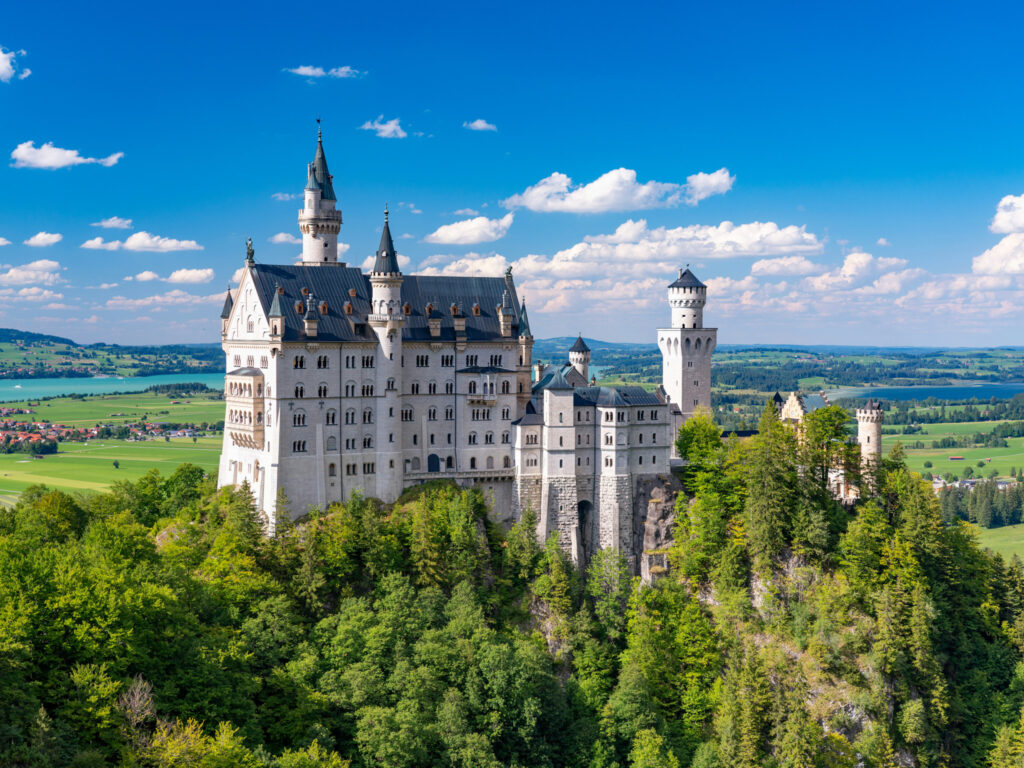
Neuschwanstein Castle is the grand finale of the Romantic Road – the fairy-tale castle that inspired Disney, perched on a rocky outcrop above a gorge with the Alps as a backdrop.
Built by King Ludwig II in the late 19th century, Neuschwanstein is pure fantasy – a medieval castle reimagined through a romantic, theatrical lens. The exterior is instantly recognisable, and the setting is spectacular: forests, mountains, the turquoise Alpsee below, and Hohenschwangau visible across the valley.
The interior is ornate – throne room, singers’ hall, lavishly decorated chambers – though only a fraction of the planned rooms were completed before Ludwig’s mysterious death.
The best views of Neuschwanstein are from Marienbrücke (Mary’s Bridge), which spans a gorge behind the castle. The bridge offers the classic postcard view – the castle framed by mountains and forest.
The area around Schwangau is stunning. The Alpsee and Schwansee lakes are beautiful for walking, and the mountains offer endless hiking trails. This is where the Romantic Road meets the Alps, and the landscape is breathtaking.
Füssen: The Alpine Finale
Füssen marks the southern end of the Romantic Road. This small town sits at the foot of the Alps, surrounded by mountains, lakes, and forests. The old town is pretty – cobbled streets, painted facades, and the High Castle (Hohes Schloss) overlooking the Lech River gorge.
The Lech Gorge just outside town is dramatic – a narrow canyon with turquoise water rushing through. There’s a walkway along the gorge that offers spectacular views.
Füssen’s real appeal is its setting. You’re in the Alps now, with hiking trails, cable cars up to mountain viewpoints, and some of Bavaria’s most beautiful scenery in every direction. The Tegelberg Cable Car offers panoramic views over the castles, lakes, and mountains.
The countryside around Füssen is Alpine perfection – green meadows in summer, snow-capped peaks, dark forests, and crystal-clear lakes. It’s the dramatic conclusion to a journey that began in the gentle wine country of Franconia.
The Countryside: What Makes the Romantic Road Special
The towns and castles are the highlights, but the countryside between them is what makes the Romantic Road truly romantic. The landscape changes beautifully as you travel south.
Northern section (Würzburg to Rothenburg): Gentle hills covered in vineyards, the Tauber Valley with its forested slopes, small wine villages, and a softer, greener landscape. This is Franconia – wine country with half-timbered farmhouses and church spires visible across rolling fields.
Central section (Rothenburg to Augsburg): Open agricultural plains, medieval towns rising from flat farmland, the Ries crater’s distinctive circular landscape, fields of wheat and sunflowers, and big skies. It’s less dramatic but peaceful and classically rural.
Southern section (Augsburg to Füssen): The landscape shifts into Alpine foothills – forests, lakes, green hills, and the mountains growing closer. Baroque churches sit in meadows, forests become denser, and the sense of approaching the Alps builds. By the time you reach Füssen, you’re surrounded by dramatic peaks and Alpine scenery.
The route is particularly beautiful in late spring (May-June) when everything is green and wildflowers bloom in the meadows, and in autumn (September-October) when the forests turn gold and the light is soft and warm.
How to Travel the Romantic Road
There are several ways to experience the route, each with advantages depending on your time, budget, and travel style.
By Car
Driving gives you the most flexibility. You can stop wherever you like, explore smaller villages off the main route, and set your own pace. The entire route takes about 6-7 hours of driving without stops, but most people spread it over 3-5 days to really explore.
The route is well-signposted with brown ‘Romantische Straße’ signs. Roads are good quality, and driving is straightforward. Parking in the medieval towns can be tricky – most old towns are pedestrianised, so you’ll park outside the walls and walk in.
Recommended pace: 4-5 days, selecting 5-6 towns to explore properly rather than trying to see everything.
By Train
The Romantic Road isn’t a single train line, but you can connect most major towns by train with occasional bus connections. Würzburg, Augsburg, and Füssen are all on main rail lines, while smaller towns like Rothenburg and Dinkelsbühl require regional trains or buses.
Germany’s rail network is excellent, and trains are comfortable and reliable. The Deutschland-Ticket (€63/month for unlimited regional travel) makes train travel very affordable if you’re spending time in Germany.
Recommended pace: 5-7 days, focusing on towns with good rail connections.
By Bus (Romantic Road Coach)
The Romantic Road Coach is a dedicated tourist bus that runs the entire route from Frankfurt/Würzburg to Füssen (and vice versa) from April to October. You can hop on and off at any stop, and it’s a convenient option if you don’t want to drive.
The coach runs daily, stopping at all major towns. It’s slower than driving (the full journey takes about 12 hours with stops) but takes the logistics out of planning.
Recommended pace: Use the coach for sections, staying overnight in 3-4 towns.
By Bicycle
The Romantic Road is a popular cycle route. It’s about 460km from end to end, mostly on quiet roads and dedicated cycle paths. The terrain is gentle in the northern and central sections, with some hillier stretches in the south.
Cycling gives you an intimate experience of the countryside – you’re moving slowly enough to notice details, and the landscapes unfold beautifully. Most cyclists take 7-10 days, averaging 50-70km per day.
Recommended pace: 7-10 days, with rest days in places like Rothenburg and Füssen.
How Long You Need on the Romantic Road
3-4 days: Enough to see the absolute highlights – Würzburg, Rothenburg, one or two smaller towns, and Füssen with Neuschwanstein. You’ll be moving fairly quickly but can experience the essence of the route.
5-7 days: The ideal amount of time. You can explore the major towns thoroughly, add smaller stops like Dinkelsbühl and Nördlingen, visit Wieskirche, and spend time in the countryside without rushing.
7-10 days: Perfect if you’re cycling or want to explore deeply. Time for detours, longer walks, leisurely meals, and really soaking up the landscapes and local culture.
The Romantic Road isn’t about ticking off every town – it’s about choosing the places that appeal to you most and experiencing them properly. Whether you’re drawn to castles, medieval architecture, baroque churches, or Alpine scenery, there’s something here that will stay with you long after the journey ends.