There’s a moment on the Lake Lucerne boat cruise – somewhere between watching the mountains rise steeply out of the water and realising you’ve been quietly staring for twenty minutes – where Switzerland fully justifies every word ever written about it. The lake earns it. You’ll feel it too.
We spent a long weekend here in spring, and I’ll be honest: it completely delivered. The city is one of the most beautiful in Europe (genuinely), the boat trip is one of those experiences you talk about for years, and the surrounding mountains offer some of the best accessible hiking you’ll find anywhere. Add in villages that look straight out of a painting and you’ve got a trip that works from basically every angle.
Here’s the full guide – city, lake, villages, hikes, practical tips – so you can plan yours properly.
Why Spring Is the Best Time to Visit Lake Lucerne
Spring visits to Lucerne hit a very specific sweet spot. April through early June brings wildflowers on the mountain slopes, clear air that makes the peaks look genuinely close, and noticeably fewer crowds than peak summer. The lake boat services run on spring timetables from mid-April, and the mountain railways at Rigi and Pilatus operate throughout – though some cable cars come back online in April, so it’s worth checking specific timetables if you’re planning a mountain day.
The light is also extraordinary in spring. Low sun angles, green hillsides still fresh, snow dusting the higher peaks. Everything looks slightly more cinematic than it has any right to.
Temperature-wise, expect 10-18°C at lake level in May – good walking weather, especially combined with long daylight hours.
First: Lucerne City
Before you get on a boat or up a mountain, give Lucerne itself proper time. Most people underestimate it. Two to three hours in the old town is the minimum – a half-day is better.
Chapel Bridge (Kapellbrücke)
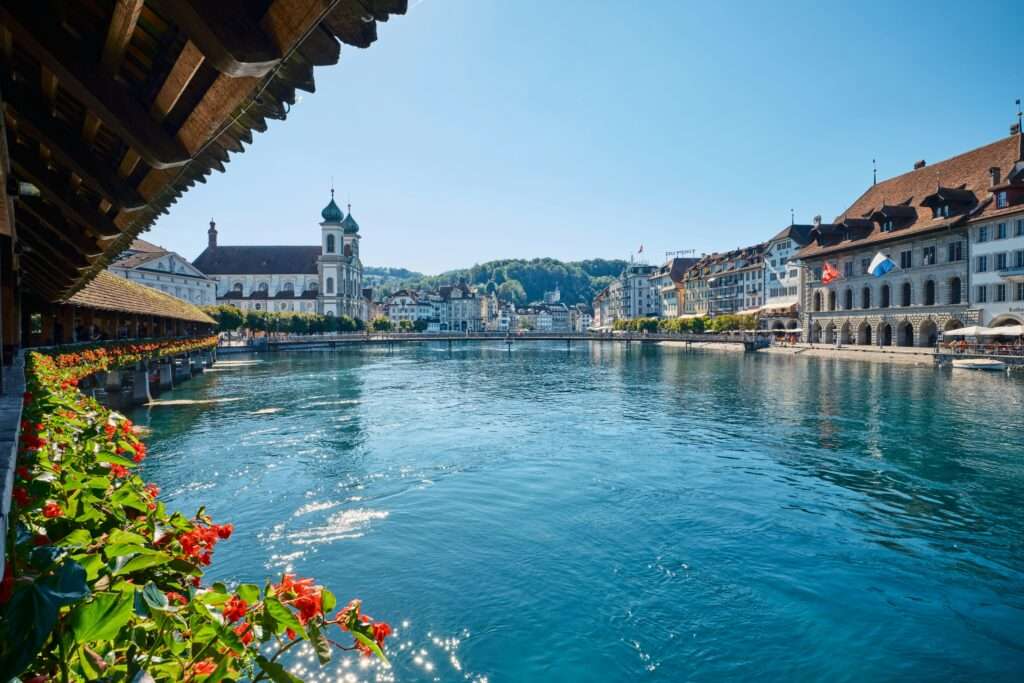
Start here. The Chapel Bridge is Lucerne’s most photographed landmark and, unusually for something so famous, it completely lives up to the hype. It’s a covered wooden footbridge built in the 14th century, spanning the River Reuss between the old and new towns, with the octagonal Water Tower rising from the water at its midpoint. Under the roof, triangular 17th-century paintings depict scenes from Swiss history and the lives of Lucerne’s patron saints.
Much of the bridge was destroyed by a fire in 1993 and rebuilt within a year – some charred panels were deliberately left in place as a reminder. Worth knowing before you visit.
The best time to be here is early morning before the tour groups arrive, or in the hour before sunset when the light on the water is genuinely exceptional. The photo spot opposite the tower from the riverbank gives the most satisfying full-frame view.
The Old Town (Altstadt)
Cross the Chapel Bridge and spend an hour getting genuinely lost in the old town. Car-free cobbled streets, frescoed facades, painted fountains, and squares that open up unexpectedly. The Weinmarkt, Hirschenplatz, and Kornmarkt are all worth wandering through. There are independent shops and good cafés woven throughout – this isn’t a sanitised tourist district, it’s an actual working city that happens to look like this.
The Musegg Wall
Walk the 14th-century city walls for the best views over Lucerne’s rooftops, the lake, and the mountains beyond. Nine towers punctuate the wall, four of which are open to climb for free during summer months. The Zytturm – home to Lucerne’s oldest clock – is the most famous. The views from up here are properly special, especially in clear spring weather.
The Lion Monument (Löwendenkmal)
A few minutes’ walk from the old town, a dying lion carved directly into a sandstone cliff. It was created in 1820 to commemorate Swiss Guards who died defending the French Royal Family during the Revolution of 1792. Mark Twain called it “the most mournful and moving piece of stone in the world.” It’s not overstating it.
Practical Lucerne Tips
Lucerne is 45 minutes by direct train from Zurich on SBB Rail, and 3 hours from Geneva. The main boat station for lake cruises is right next to the train station – Pier 1 serves Weggis, Vitznau, Brunnen, and Flüelen. Overnight guests in Lucerne receive a free Visitor Card that covers local buses and trams in Zone 10 – ask your hotel for it at check-in.
The Lake Lucerne Boat Trip
Do not skip this. It is, without question, one of the best ways to spend four hours in Switzerland.
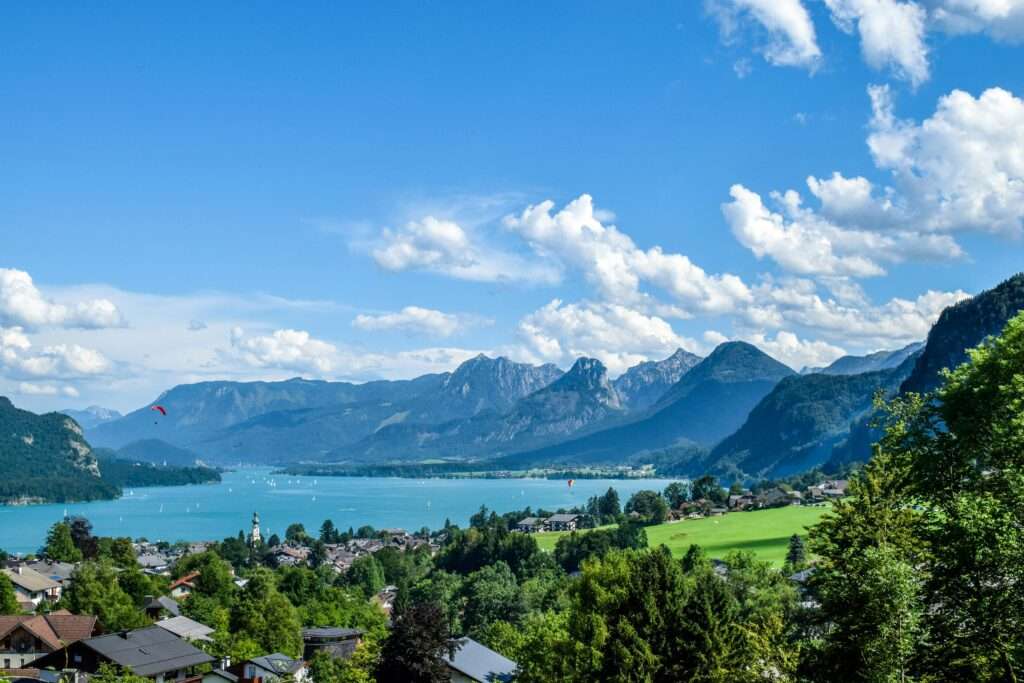
Lake Lucerne – or Vierwaldstättersee in German, meaning “lake of the four forest cantons” – covers 114 km² and has 32 boat piers dotted around its shores. Its shape is deeply irregular, with multiple arms and peninsulas that create constantly changing scenery. The northern section between Lucerne and Brunnen is open and green, with villages on the hillsides and the Alps in the distance. The southern Urnersee section – from Brunnen south toward Flüelen – is a different experience altogether: steep cliffs drop almost vertically into the water, the scale becomes dramatically bigger, and the whole thing starts to feel more like a Norwegian fjord. It’s one of the most spectacular stretches of water in Central Europe.
Choosing Your Route
For a full lake experience, the boat to Flüelen and back takes around 3.5 hours each way – most people do a partial route and hop off along the way. The classic approach is:
Lucerne – Vitznau (30-40 minutes): The most popular section for combining with a Mount Rigi excursion. The cogwheel railway departs from the jetty in Vitznau.
Lucerne – Weggis (30 minutes): Weggis is the “Riviera” of the lake – mild microclimate, palm trees along the promenade, the Rigi cable car accessible from here. Good for a short escape with a coffee and a walk.
Lucerne – Brunnen (1.5 hours): Takes you through the widest part of the lake before the scenery starts to close in. Brunnen has a lovely waterfront.
Lucerne – Flüelen (3.5 hours): The full southern experience through the Urnersee. Do this on a clear day if you can.
Lucerne – Treib (around 1 hour): Stop here for the short funicular up to Seelisberg, and the path toward the Rütli meadow – more on that below.
The Boats
Lake Lucerne Navigation (SGV) operates the service year-round. The fleet includes historic paddle steamers alongside modern boats – if you have the option, the old steamers add something. The boats have onboard restaurants and outdoor decks. Reservations are not required for standard services, though you can book a table in the restaurant in advance.
Spring timetables typically begin from mid-April and run through May with frequent departures. The full summer timetable starts in late May.
Tickets and passes: Regular scheduled services are fully covered by the Swiss Travel Pass. If you don’t have a pass, a Lake Lucerne day ticket costs CHF 53 per adult for unlimited boat travel – excellent value if you’re planning a full day of hop-on hop-off. Tickets can be bought at the Lucerne dock, at Weggis, at Brunnen and Vitznau (spring to autumn), or onboard.
One key practical note: Always check the timetable before planning your day around specific stops. Spring schedules have more limited frequency than summer, and some smaller stops have infrequent service. Build in flexibility.
The Villages Worth Stopping At
Weggis
Weggis is the most accessible and polished of the lake villages – a 30-minute boat ride from Lucerne. The mild microclimate here supports palm trees, fig trees, and chestnut trees along the promenade, giving it a slightly Mediterranean feel that catches most visitors off guard. There’s a memorial stone to Mark Twain, who lived here for a period, on the promenade toward Vitznau.
The village is best used as a base for Rigi or as a pleasant hour-long stop – walk the waterfront, have a coffee, take the cable car toward Rigi Kaltbad if you’re combining it with a mountain day. It’s also the starting point of the easy 30-minute promenade walk to Vitznau along the lake’s edge.
Vitznau
Smaller and quieter than Weggis, Vitznau matters primarily because it’s the departure point for Europe’s oldest mountain railway. The cogwheel train to Rigi Kulm has been running from here since 1871 – it departs right from the jetty, so you can step off the lake boat and onto the mountain train in minutes. The village itself is pleasant without being particularly eventful, but the transition from lake to mountain here is one of the best Switzerland offers.
Gersau
Continuing around the lake from Vitznau, Gersau is a quiet village with an interesting claim: it was an independent republic for more than four centuries, from 1390 to 1798. Today it’s a peaceful lakeside stop with a nice old town and good lake views. It’s less visited than Weggis and Vitznau, which is part of the appeal.
Brunnen
Brunnen sits at the elbow where the lake turns from north-west to south-east – a genuine geographical pivot point, which means the views from the waterfront cover both the wider northern lake and the beginning of the dramatic Urnersee arm. It’s more of a town than a village and is a useful base if you want easier access to the southern lake sections, the Rütli meadow, or the Swiss Path hiking trail.
Seelisberg
Not directly on the lake, but accessed by a short funicular from the Treib jetty (8 minutes). Seelisberg sits high above the water on a clifftop, and the views from here cover both the northern and southern sections of the lake simultaneously – it’s one of the best panoramic viewpoints in the whole region. The tiny village of Seelisberg is genuine and unhurried. This is a stop for people who want to see the lake differently, from above.
The Hikes Worth Doing
Lake Lucerne’s hiking options are some of the best in Switzerland for accessibility – almost everything is reachable by boat, train, or cable car, meaning you can hike one-way and return by transport. Here are the ones that are genuinely worth your time in spring.
1. Rigi Panorama Trail – Easy to Moderate / 7km / 1.5-2 hours
This is the classic Lake Lucerne hike, and it earns that status. Mount Rigi – the “Queen of the Mountains” – rises between Lakes Lucerne, Zug, and Lauerz, and on a clear day the views from the ridge cover four countries. At 1,798m, it’s not challenging to reach: the cogwheel train from Vitznau takes 30 minutes to the summit at Rigi Kulm.
The Panorama Trail runs along the ridgeline from Rigi Kaltbad (a mid-station) to Rigi Scheidegg, covering 7km with around 250m of elevation change. It’s wide, well-maintained, and suitable for all fitness levels. The views over Lake Lucerne to the west and the Swiss plateau to the north are extraordinary – the kind that make you stop walking entirely and just stand there for a while.
The best loop: Boat from Lucerne to Vitznau → cogwheel train to Rigi Kulm → short walk around the summit → walk or train down to Rigi Kaltbad → cable car down to Weggis → boat back to Lucerne. Allow a full day.
Rigi Kaltbad Mineral Baths & Spa: If you want to end the day properly, the mineral baths at Rigi Kaltbad were designed by celebrated Swiss architect Mario Botta. Outdoor pools with direct views of the lake, indoor mineral baths, saunas. It’s expensive (expect to pay CHF 35-40 for entry) but worth it for the experience.
Cogwheel train tickets: A round trip from Vitznau to Rigi Kulm costs approximately CHF 72-78 for adults. With the Swiss Travel Pass, the cogwheel trains from Vitznau and Arth-Goldau are fully covered (free). The cable cars from Weggis get a 50% discount with the pass.
Spring note: Trails at Rigi are generally accessible from late April. Check the Rigi Railways website (rigi.ch) for current trail status and timetables before visiting – there are multiple seasonal timetables throughout the year.
2. Bürgenstock Felsenweg (Cliff Path) – Easy / 5.2km / 2-2.5 hours
The Felsenweg is Lake Lucerne hiking at its most cinematic. Bürgenstock is the wooded peninsula that rises directly from the lake close to Lucerne, and the cliff path – built into the northern rockface between 1897 and 1902 – is carved along the cliff edge with open views of the lake and mountains throughout. The path is almost entirely shaded by forest, which makes it comfortable on warmer spring days.
The trail runs 2.2km from the Bürgenstock Resort to the Känzeli viewpoint (out and back for 4.4km total), with informative panels along the route explaining the geology and history of the mountain. The ground is gravel and stable – suitable for most fitness levels. Allow around 2 hours including stops.
Midway through, you can take a short detour to ride the Hammetschwand Lift – Europe’s highest outdoor lift, climbing 153m in a glass car up the cliff face. The panorama from the top is spectacular. It costs extra beyond the Bürgenstock access ticket.
Getting there: Boat from Lucerne to Kehrsiten-Bürgenstock (around 25 minutes), then the funicular up to the resort. The combined round trip costs around CHF 90 per adult in summer (less in winter). The Swiss Travel Pass gives a 50% discount on the funicular.
Spring note: The Felsenweg is open from around May through October. It’s closed in winter and blocked at the gate from November.
3. Rütli Meadow and Seelisberg – Moderate / Stage 1 of the Swiss Path / 9km / 3-3.5 hours
This is the most historically loaded walk in Switzerland, and it delivers on scenery as much as significance.
The Rütli Meadow is where representatives of the founding cantons of Uri, Schwyz, and Unterwalden took their oath in 1291 – the founding act of the Swiss Confederation. It’s considered the birthplace of Switzerland. The meadow itself is deliberately understated – a flagpole, an information panel, and a grassy hillside above the lake – which somehow makes it more affecting rather than less.
The walk follows Stage 1 of the Swiss Path (Weg der Schweiz), a 35km commemorative trail opened in 1991 for the 700th anniversary of Switzerland. From the Rütli, the path climbs steeply through pine forest with expanding views of the Urnersee below, reaching the clifftop village of Seelisberg after around an hour. From Seelisberg, the path descends gradually through forest and farms to the tiny village of Bauen on the lake’s edge, where you can catch the ferry back toward Lucerne or Brunnen.
Getting there: Boat from Brunnen to Rütli (around 10 minutes across the lake). Return by boat from Bauen. Check timetables carefully – Bauen has limited ferry frequency, particularly on spring schedules.
Spring note: This is a good choice for spring precisely because it’s at lower elevation than Rigi. Trails are usually clear from April onwards.
Shortcut: If you’d rather not do the steep climb from Rütli to Seelisberg, take the boat to Treib instead and ride the 8-minute funicular up to Seelisberg, joining the Swiss Path there and hiking down to Bauen.
4. Weggis to Vitznau Promenade – Easy / 4km / 45-60 minutes
This is the one for when you want scenery without serious effort. The lakeside promenade from Weggis to Vitznau runs along the water’s edge past gardens, historic buildings, and beautiful lake views. In spring, flowers are coming into bloom along the route. It’s flat, well-surfaced, and good for any level of fitness.
Combined with a coffee in Weggis and the cogwheel train from Vitznau, this makes an excellent gentle half-day.
Mount Pilatus
Rigi gets most of the attention, but Pilatus – the jagged peak that forms the dramatic backdrop to Lucerne city – deserves its own paragraph.
The classic Pilatus excursion from Lucerne is done as a circular trip: boat from Lucerne to Alpnachstad, then the world’s steepest cogwheel railway up to Pilatus Kulm at 2,132m (gradient of up to 48%), then cable car and gondola back down to Kriens, then bus back to Lucerne. Allow a full day and check weather carefully – Pilatus is frequently in cloud, and the views at the top are what you’re there for.
The cogwheel railway operates seasonally – typically May through November. The cable car side runs year-round. With the Swiss Travel Pass, you get a 50% discount on the Pilatus Railway and cable car.
Choosing between Rigi and Pilatus for a spring long weekend: Both are worth it if you have three days. If you only have time for one, Rigi is slightly more accessible in early spring (mid-April onwards vs May for the Pilatus cogwheel train), the Panorama Trail is a better dedicated hike, and the Classic Round Trip by boat and cogwheel train is one of the most satisfying circuits in Switzerland.
Practical Guide for a Long Weekend
How Long Do You Need?
Three nights gives you enough time to do the city justice, get a full lake cruise day in, and spend one day on a mountain. Four nights is more comfortable if you want to do two separate mountain/village days.
Getting There
From London: Eurostar from St Pancras to Paris Gare du Nord (2.5 hours), then Paris Gare de Lyon to Basel or Zurich, then direct train to Lucerne. Door to door from London is around 8-9 hours. Alternatively, fly direct to Zurich – Lucerne is 45 minutes from Zurich airport by direct train.
Where to Stay
Lucerne is the best base – the most options, the best evening atmosphere, and the easiest access to the lake boats from the main pier next to the station. Weggis and Vitznau both work well if you want something quieter – wellness hotels with lake views and direct Rigi access are the main draw.
Swiss Travel Pass
For a long weekend in Lake Lucerne specifically, the pass is worth running the numbers on. A 3-day 2nd class pass starts at CHF 254 in 2026. It covers: all lake boats (scheduled services), the cogwheel trains from Vitznau and Arth-Goldau to Rigi Kulm, Pilatus cable cars and the Pilatus Railway at 50% off, the Bürgenstock funicular at 50% off, trains between Lucerne and Zurich or other cities, and entry to the Swiss Museum of Transport.
If you’re doing the lake cruise, a mountain day, and the Bürgenstock, the pass can pay for itself quickly. Use the SBB website to price up your planned activities individually and compare.
Weather and What to Pack
Spring weather in Lucerne is variable – pack layers and waterproofs. Mountain weather is even less predictable; check mountain webcams the evening before any planned summit day. Always carry a warm layer even if it’s warm at lake level.
Good walking shoes are essential if you’re doing any trails. The Felsenweg and Weggis-Vitznau promenade are fine in trainers; the Rigi Panorama Trail and Swiss Path Stage 1 benefit from proper walking boots, particularly in early spring when paths can be damp.
Final Thoughts
Lake Lucerne is one of those trips that doesn’t require much persuasion after the fact – you come back and everyone immediately understands why you went. The combination of an extraordinary city, a genuinely dramatic lake, world-class mountain access, and a public transport network that makes all of it effortless to navigate is basically unmatched anywhere in Europe.